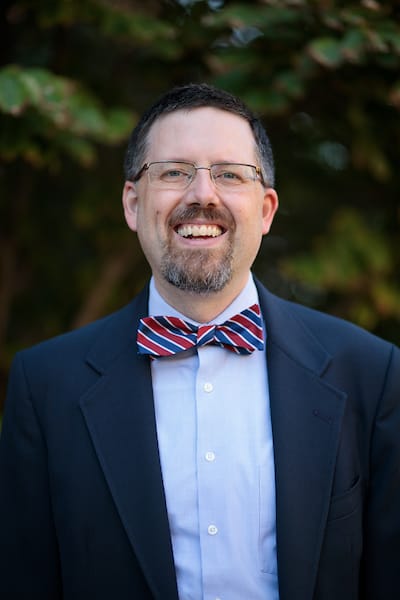
Jonathan Den Hartog
Professor and Chair, Department of History at Samford University
Dr. Jonathan Den Hartog is the Carolyn and Don Drennen Chair of History, Civics, and the Constitution at Samford University in Birmingham, Alabama, where he is also the Chair of the History Department. He came to Samford in 2019 after teaching in St. Paul, Minnesota for 13 years. He spent the 2012-13 academic year as the Garwood Visiting Fellow at the James Madison Program in American Ideals and Institutions at Princeton University. He received his Ph.D. in American History from the University of Notre Dame. Den Hartog enjoys writing and speaking about the religious and political history of the colonial, revolutionary, and early national periods of America. Den Hartog’s first book, Patriotism and Piety: Federalist Politics and Religious Struggle in the New American Nation was published by the University of Virginia Press in 2015. Most recently, he published a volume he co-edited on Disestablishment and Religious Dissent: Church-State Relations in the New American States, 1776-1833. His public writing has appeared in The Wall Street Journal, The Philadelphia Inquirer, and TheHill.com. He has given numerous public talks to community groups, including the Mayflower Society, Sons and Daughters of Colonial Wars, Sons of the American Revolution, and many church groups. He has served as a Scholar-Advisor to the American Bible Society on several faith-and-liberty initiatives.
Talks and Topics
“The Road to American Independence.”
How did Americans reach the point of declaring independence against Great Britain, the most powerful nation on earth in 1776? This talk will trace the principles, peoples, and events that brought the members of the Continental Congress to vote for independence. By considering the principles of the American Founding, we will be better able to live as citizens today and carry on the American experiment tomorrow.
“Faith and the American Revolution” or “Christians in the American Revolution.”
How did faith influence the American Revolution? Although Americans across the political spectrum in 1776 were deeply committed to reading and following the Bible, they came to differing approaches to the American Revolution. This talk will consider the different paths people of faith walked in the Revolution and how faith sustained them through great difficulties.
“John Jay’s American Revolution.”
How did a careful lawyer come to be convinced of the need for independence? A founding father who filled many important roles in the American Revolution is John Jay of New York. Jay was a delegate to the First and Second Continental Congress, and this talk will trace how he came to be committed to the American cause. He would go on to render important service for his state and his nation and even to be the key diplomat for securing the peace treaty that ended the War for Independence. Jay is remembered as the First Chief Justice of the Supreme Court, but his service began in the early years of the American Revolution.
“Elias Boudinot: Huguenot Patriot.”
How can ordinary service lead in extraordinary directions? Elias Boudinot of New Jersey was content to serve his community as a lawyer until the Revolutionary War appeared. In serving others as a Christian, his responsibilities increased until he reported directly to General George Washington. His cheerful commitment to the Revolution made a real impact for thousands during and after the war. As a descendent of the Huguenot refugees in America, Boudinot shows how he was committed to the homeland that had welcomed his French ancestors.