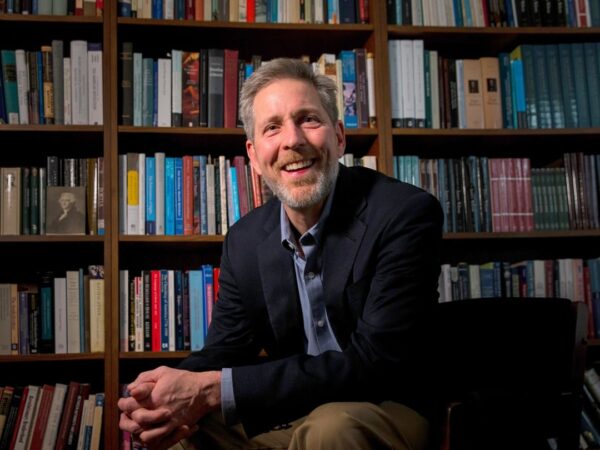
Kirstin Anderson Birkhaug
Assistant Professor of Political Science, Hope College
Dr. Kirstin Anderson Birkhaug is an Assistant Professor of Political Science at Hope College, where she teaches classes in political theory and American politics, and of which is she is also an alumna. She received her Ph.D. in political theory and American politics from the University of Wisconsin-Madison in 2023. Dr. Birkhaug’s research is primarily on early American political thought with an emphasis on the contributions of women.
Talks and Topics
Mercy Otis Warren and the Hand of Providence
Mercy Otis Warren, one of the first historians of the American Revolution and perhaps the most politically significant woman of the Founding generation, maintained that the United States had been uniquely blessed by God and must endeavor to preserve these providential blessings. In this talk, I explore how Warren used religious rhetoric to describe the great comparative advantage of the United States—its commitment to individual liberty—as well as her prescription for retaining God’s favor in the future, which is essentially a robust civil religion based in a shared national memory.
Phillis Wheatley and the Divine Right to Liberty
Phillis Wheatley was a Revolutionary-era poet from Boston who also lived most of her life enslaved to a wealthy Bostonian family. Many of Wheatley’s poems explore the myriad tensions of her life—her genius and her enslavement, her patriotism and her want of true belonging, her importance and her lack thereof. Wheatley’s Christian religion, which she held seriously and faithfully, also features in her writing, though not always straightforwardly. In this talk, I illustrate how Wheatley subtly uses Christian theology within her poetry and public writings to advocate for freedom for both herself and other enslaved peoples.
The Jeffersonian Gap: Explaining Jefferson’s Greatest Failure
Those who study Jefferson in any capacity often find themselves confronted with a seeming paradox: that Jefferson is perhaps the foremost American philosopher of liberty, and yet he held slaves his whole life and did not fully manumit them even upon his death. This paradox—which I term the “Jeffersonian Gap”—is often given superficial explanation and sometimes waved away. I argue that the Jeffersonian Gap proceeds from a central problem in Jefferson’s thought, namely his reliance on empirical anthropology to prove a human right to liberty, as opposed to (specifically Christian) metaphysics. As such, Jefferson’s theory of liberty failed, in his lifetime and beyond, to truly liberate the people who needed liberation most.
Abraham Lincoln’s American Covenant
That Lincoln is perhaps the foremost American political theologian is well established. What is less well-established, however, is the extent to which Lincoln admired the political model of the ancient Hebrews (as furnished by the Old Testament), especially its political uses of collective memory. This talk asserts that Lincoln’s invocations of the American Founding attempt to establish, across his rhetorical oeuvre, a collective American memory of those events imbued with religious significance. Using Exodus as his instructive story, Lincoln uses the political strategies of the ancient Hebrews to support the continuity of the Union.
Kirstin Anderson Birkhaug’s Upcoming Events
24 Mar 26
Bible First: Politics
Philadelphia, PA: “Politics and Religion Go Great Together (But How?)” American Bible Society and the Center for Hebraic Thought welcome you to a two-day interdisciplinary conference, Bible First: Politics. Join us on March 24–25, 2026 (Tuesday–Wednesday) in Philadelphia PA at the American Bible Society Collaboration Center on Independence Mall. This event is for pastors, thought leaders, and […]