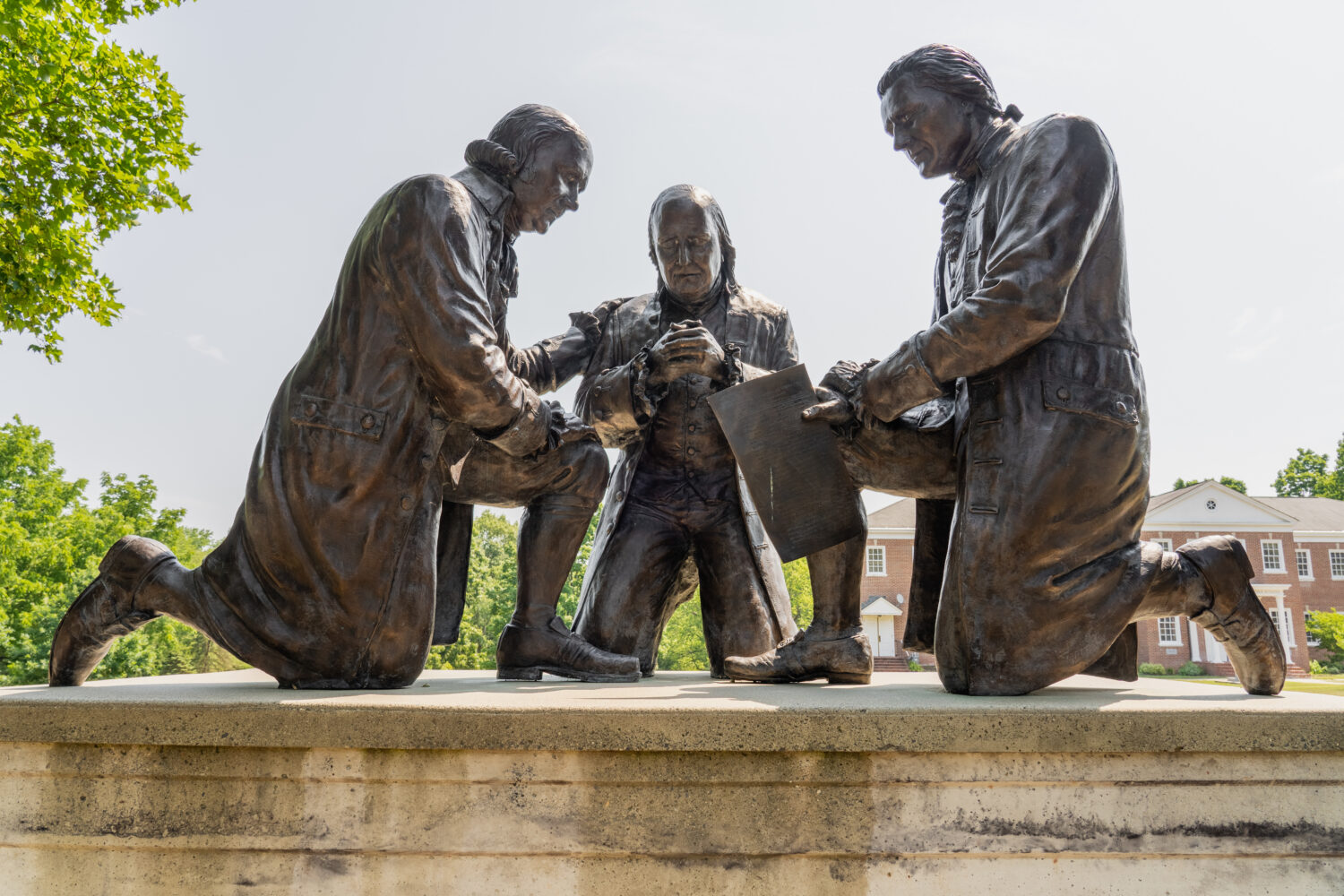

We live in an age when there is an unfortunate inclination among many in the secular academy, mainstream media, and, increasingly, popular culture to dismiss—even erase—acknowledgements of God, faith, and the Bible in American history. The American founding, which we celebrate in this year of America 250, is typically described as a strictly secular project informed by Enlightenment ideas and committed to a separation of religion from public life.
More circumspect students of American history know, however, that the story of the nation’s founding cannot be told accurately or adequately if we miss or dismiss the Bible’s contributions to the American experiment in republican self-government and ordered liberty. The Bible, after all, was the most accessible and authoritative book in seventeenth- and eighteenth-century America. Not surprisingly, it left its mark on diverse aspects of culture, including education, arts and letters, government, and law. The Bible was vital to literacy education (and education more generally), moral instruction, and spiritual formation. It informed the political thought and projects in both the colonies and, later, the new nation.
Christianity and its sacred text featured prominently in colonial America. The first permanent settlements in New England, for example, were established as Bible commonwealths grounded on biblical principles and laws as the colonists understood them. Colonial laws drew extensively from biblical sources, especially the laws of Moses. And lest there be any doubt about the source, colonial legal codes often included biblical references in support of provisions contained in them. The colonists, to be sure, did not adopt all aspects of biblical law, and Scripture was not the sole source of their laws. And yet, the Bible was woven into the fabric of colonial legal culture; in their law, anything inconsistent with divine revelation was deemed invalid.
Founding a Nation Shaped by Scripture
The Bible retained a place of prominence in the world of the Founding Fathers who, at the end of the eighteenth century, fought for and secured independence from Great Britain and established new governments in their respective states and nation. Although the Founders drew on diverse sources, including the English common law and constitutionalism, classical republicanism, and Enlightenment ideas, the Bible was vital to their political thought and practices. Its ideas shaped their habits of mind and informed their political pursuits.
One study of the influences on the political discourse of the founding era reported that the Bible accounted for approximately one-third of the citations in the literature surveyed. The Bible was referenced more frequently than any political philosopher or even any school of thought. The book of Deuteronomy was the most frequently cited work, followed by Montesquieu’s The Spirit of the Laws (1748).1
Many in the founding generation looked to Scripture for political principles, precedents, and normative standards. Here are a few examples:
- The exodus narrative (Exodus 1—14) is a story of liberation that inspired patriotic Americans in their struggles against the “tyranny” of King George III.
- Stories of the Hebrew midwives, the prophet Daniel, the imprisoned Peter and other apostles recounted in Acts 5, among other heroic figures, taught them that a righteous people have a right—even a duty—to resist unjust, tyrannical rulers. This idea was important for pious Americans contemplating resistance to the English crown and parliament.
- The profile of a righteous ruler in Exodus 18:21 identified the characteristics Americans thought they should look for in their own leaders; that is, able men who fear God, love truth, and hate covetousness.
- There were Americans who believed the Hebrew commonwealth that governed the children of Israel from the exodus to the coronation of Saul as king of Israel provided a model of republican government worthy of their study and, perhaps, emulation in their own polities.
- The founding generation often premised honest oath-taking on a belief in a future state of rewards and punishments, as described in Scripture.
Perhaps most important, the Bible informed the Founders’ view of human nature. They learned from Scripture, as well as from their own experiences, that man was a fallen, sinful creature, governed by selfish interests.
The Founders frequently identified the Bible as the authoritative guide to understanding human nature. Doctor Benjamin Rush, a venerated signer of the U.S. Declaration of Independence, wrote: “In the Bible alone man is described as he is.”2 Rush further claimed that “the Bible is the only correct map of the human heart that ever has been published. It contains a faithful representation of all its follies, Vices & Crimes.”3 Gouverneur Morris, the delegate arguably most responsible for the structure and language of the U.S. Constitution framed in Philadelphia, similarly looked to Scripture for insights into the nature of man: “the holy writings [i.e., the Bible] … tell us what man is, and they, alone, tell us why he is what he is: a contradictory creature that, seeing and approving what is good, pursues and performs what is evil.”4
The Bible, of course, gives an account of man’s fall in the Garden of Eden (Genesis 3) and how through “one man’s transgression” (Romans 5:12), sin entered the world and was passed on to all humanity. John Adams drew the connection between Adam’s transgression in the garden and humankind’s tainted nature, writing: “what a Mass of Corruption human Nature has been in general, since the Fall of Adam.…”5 John Witherspoon, another signer of the Declaration of Independence, similarly observed that “[t]he deplorable wickedness in which the world in general is overwhelmed, hath flowed in a continued stream from the first sin of Adam.…”6
More specifically, the Founders often looked to Scripture for descriptions of humankind in its fallen state. For example, John Adams, quoting Jeremiah 17:9, “advis[ed] all men to look into their own hearts, which they will find to be deceitful above all things and desperately wicked.”7 Roger Sherman, a signer of both the Declaration of Independence and U.S. Constitution, wrote that humankind is in a “state of depravity, guilt and misery, … dead in trespasses and sins [Ephesians 2:1]; – by nature prone to evil and averse to the good.…”8 In short, the Founders’ anthropology was informed by a biblical understanding of the nature of man.
Building a Government by the Book
The Founders knew that, if the new civil governments they labored to build following independence were to succeed, they must take into account, in the words of Federalist No. 37, “the infirmities and depravities of the human character.”9 Their view of human nature, in other words, formed the foundation of their political theory.
Benjamin Rush candidly acknowledged the “human depravity … recorded in the Bible,” before counseling that humankind “can be governed of Course only by accommodating laws to his Nature as developed in that sacred book.”10 He warned, in other words, that the Founders’ plans for civil government and constitutional designs could not hope to succeed if they were not based on a realistic appraisal of human nature.
The Founders knew that, because of humankind’s fallen nature, those vested with government power are inclined to aggrandize that power, and, in so doing, threaten and even abridge the liberties of those they govern. In a 1787 speech, shortly after the Constitutional Convention, James Wilson said: “It is the nature of man to pursue his own interest, in preference to the public good.”11 To control this sinful, selfish impulse, numerous checks on government power and those entrusted with administering that power were required.
Significantly, this view of humankind was discussed in the Philadelphia Convention that framed the U.S. Constitution in the summer of 1787. In a July 11, 1787, speech, for example, James Madison acknowledged a fellow delegate’s strong view regarding “the political depravity of men, and the necessity of checking one vice and interest by opposing to them another vice & interest…. The truth was,” Madison concurred, “that all men having power ought to be distrusted to a certain degree.”12
The United States Constitution evinces general themes and specific principles familiar to a Bible-reading people. As we have just mentioned, the Founders’ political anthropology informed by a biblical anthropology explains the Constitution’s near obsession with the separation of powers and robust checks on the exercise of government power.
The Constitution also includes specific provisions that were derived from or informed by biblical doctrines and practices. Long before these concepts were written into the Constitution, Americans had learned from eminent jurists in England and America that they were grounded in the word and “law of God.”13
Constitutional provisions reflecting biblical influence include the following:
- Article I, § 8, cl. 5, granting Congress the authority to “fix the Standard of Weights and Measures” (see Deuteronomy 25:13–15);
- Article III, § 3, cl. 1, requiring “the testimony of two witnesses” to secure a conviction for treason (see Deuteronomy 17:6);
- the Fifth Amendment disallowing double jeopardy (see Nahum 1:9); and
- the Eighth Amendment prohibiting “cruel and unusual punishments” (see, e.g., limitations on corporal punishment in Deuteronomy 25:3).
In the context of the western legal tradition, these and other constitutional measures—such as those concerned with due process of law (see, inter alia, Exodus 23:1–9), oaths of office, and corruption of blood (see Deuteronomy 24:16 and Ezekiel 18:20)—were almost certainly derived from a biblical tradition.14 The Bible, in short, has left its mark on our Constitution and constitutional tradition.
Making a Return to Our Foundations
In the Virginia Declaration of Rights (June 12, 1776), adopted 250 years ago this year, George Mason counseled that, if we want to continue to enjoy a “free Government” with “the blessings of liberty,” we must make “frequent recurrence to fundamental principles.”15 As the nation celebrates its 250th anniversary, it is fitting that we pause to reflect on the “fundamental principles,” “inherent rights,” and liberties upon which the nation was built and acknowledge the sacred text from which many of these principles, rights, and liberties were derived. This season of semiquincentennial commemorations invites us as citizens to make recurrence and recommit ourselves to these “fundamental principles” so that we may continue to enjoy in this land a “free government” with “the blessings of liberty.”
Daniel L. Dreisbach is a professor at American University in Washington, DC. He is the author or editor of a dozen books, including Reading the Bible with the Founding Fathers (Oxford University Press), from which this article is adapted. You can follow him on X @d3bach.
- Donald S. Lutz, “The Relative Influence of European Writers on Late Eighteenth-Century American Political Thought,” American Political Science Review 78 (March 1984): 189-197; Lutz, The Origins of American Constitutionalism (Baton Rouge: Louisiana State University Press, 1988), 140; Lutz, A Preface to American Political Theory (Lawrence: University Press of Kansas, 1992), 136. ↩︎
- Benjamin Rush to John Adams, 13 January 1809 (emphasis in the original). ↩︎
- Benjamin Rush to John Adams, 23 January 1807. ↩︎
- Gouverneur Morris, An Inaugural Discourse, Delivered Before the New-York Historical Society, by the Honourable Gouverneur Morris, (President,) 4th September 1816 (New-York: by T. & W. Mercein, 1816), 7–8. ↩︎
- John Adams, Diary entry, 31 December 1772 (this appears to be from a draft of a letter written to Mrs. Maccaulay). ↩︎
- John Witherspoon, “All Mankind by Nature Under Sin,” before 1764, in The Works of the Rev. John Witherspoon, D.D., L.L.D., Late President of the College, at Princeton, New-Jersey, 4 vols., 2nd ed. (Philadelphia: William W. Woodward, 1802), 1:270. ↩︎
- [John Adams], Boston Gazette, 5 September 1763. Adams was quoting Jeremiah 17:9 (“The heart is deceitful above all things, and desperately wicked: who can know it?”). ↩︎
- [Roger Sherman], A short sermon on the duty of self examination, preparatory to receiving the Lord’s Supper (New Haven, CT: printed by Abel Morse, 1789), 5. ↩︎
- Publius (James Madison), Federalist No. 37, in Alexander Hamilton, John Jay, and James Madison, The Federalist (Gideon Edition), ed. George W. Carey and James McClellan (Indianapolis, IN: Liberty Fund, 2001), 185. ↩︎
- Benjamin Rush to John Adams, 13 January 1809. ↩︎
- James Wilson, “State House Yard Speech in Philadelphia,” 6 October 1787. ↩︎
- James Madison, speech in the Constitutional Convention, 11 July 1787, as quoted in James Madison’s Notes of Debates in the Federal Convention of 1787, in The Records of the Federal Convention of 1787, ed. Max Farrand (New Haven, CT: Yale University Press, 1911), I:584. ↩︎
- See, for example, Edward Coke, The Second Part of the Institutes of the Lawes of England, 1st ed. (London: 1642), 41 (requirement for a standard of weights and measurements in Magna Carta was “grounded upon the Law of God”); Edward Coke, The Third Part of the Institutes of the Laws of England, 1st ed. (London, 1644), 26 (requirement of two witnesses for conviction of high treason is “grounded upon the law of God”). ↩︎
- See Daniel L. Dreisbach, “Does Biblical Literacy Enrich Constitutional Literacy?: The Bible’s Forgotten Influence on the American Constitutional Tradition,” Canopy Forum on the Interactions of Law & Religion (Atlanta, GA: Emory University, Center for the Study of Law and Religion, September 23, 2020). https://canopyforum.org/2020/09/23/does-biblical-literacy-enrich-constitutional-literacy-the-bibles-forgotten-influence-on-the-american-constitutional-tradition/ ↩︎
- Virginia Declaration of Rights (June 12, 1776), art. xv. ↩︎