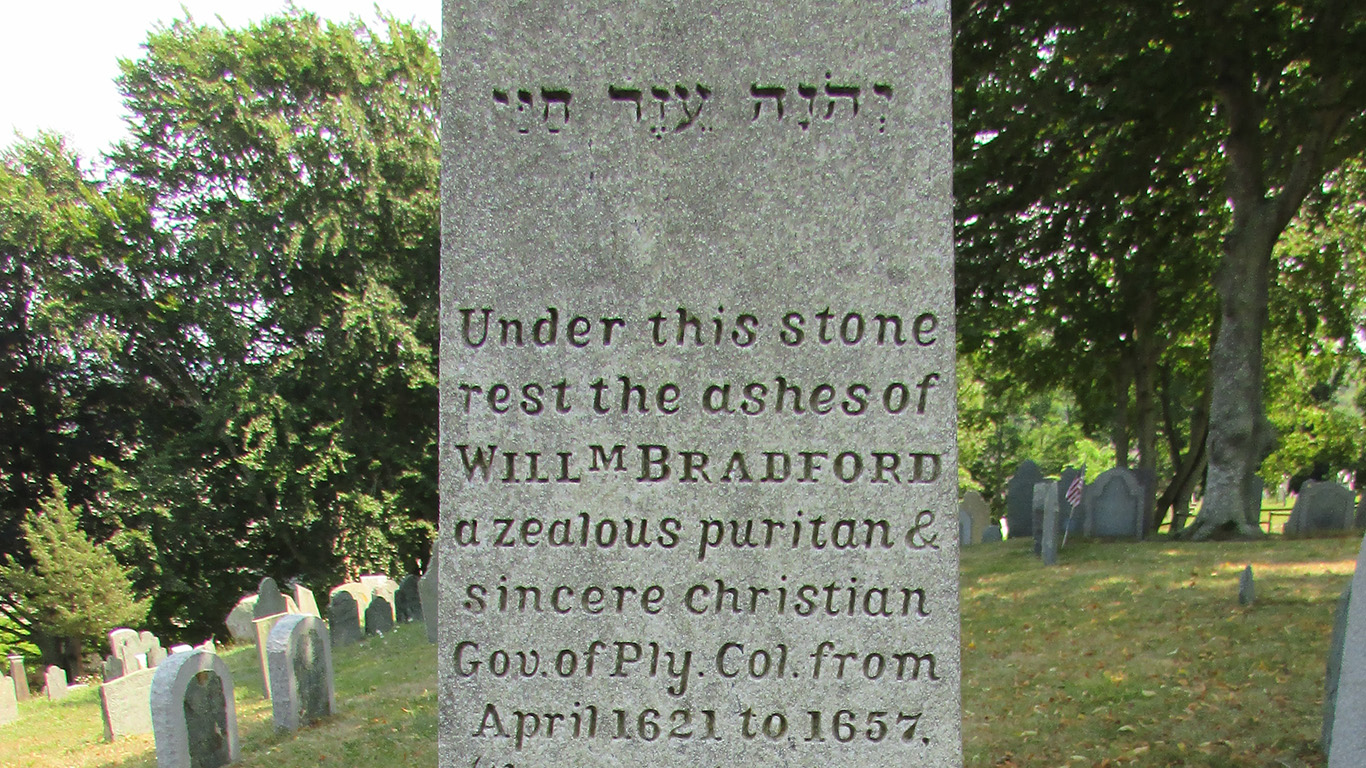

Inscribed on the tombstone of William Bradford in Plymouth, Massachusetts is a Hebrew phrase, “God is the help of my life.” Bradford was one of the most impactful Pilgrim settlers, serving as Governor of the Plymouth Colony for roughly thirty years, as well as a commissioner and president of the United Colonies of New England, each on multiple occasions. That his grave bears the literal imprint of the ancient language of the Hebrew Bible is fitting. After all, the creation of what would become the United States of America has been impacted by Israel from the beginning.
Colonial Hebraisms
Ten years after Bradford, the Puritan John Winthrop, in his famous sermon “A Model of Christian Charity,” proclaimed that “We shall find that the God of Israel is among us … when he shall make us a praise and glory that men shall say of succeeding plantations, ‘the Lord make it like that of New England.’ For we must consider that we shall be as a city upon a hill.”
Of course, as Israel Benporat notes in his unpublished doctoral dissertation Hebraic Puritans: Old Testament Politics in Early New England, “despite their fascination with Scripture, the New England Puritans viewed Judaism as erroneous and did not welcome real-life Jews in their midst.” But they often turned to Hebraic texts. After all, as Richard Bauckham has noted, “Much of the Old Testament is addressed to a people of God which was a political entity,” maintaining and enforcing God’s law, engaging in diplomacy, and waging war; while the New Testament, by contrast, “is addressed to a politically powerless minority in the Roman Empire.”
Hebraic ideas, frameworks, political concepts, and characters would thus become a fixture of the American consciousness.
In 1636, John Cotton, the preeminent theologian of the Massachusetts Bay Colony, was invited by its magistrates to suggest a draft of their fundamental laws. Cotton’s draft, titled Moses, His Judicialls, was not formally adopted, but it did influence Massachusetts law and became the basis of the legal system of the New Haven Colony in what would later become Connecticut. It contained such requirements as: “no man shall set his dwellinghouse above the distance of half a mile, or a mile at furthest, from the meeting of the congregation,” which was based on rules limiting distance travelled on the Sabbath. Other proclamations included: “All wickedness is to be removed out of the camp by severe discipline,” based on Deuteronomy 23:10–14. In 1652, a Connecticut court passed a law stipulating equal punishment for violators of both the Hebrew Bible and the New Testament.
Between 1642 and 1646, Harvard undergrads had to study Hebrew twice a day (and a Hebrew requirement persisted until 1787). Graduates were expected to be able to translate random passages from the Hebrew Bible into Latin. The seal of Yale University (established in 1701) includes the words Urim V’Thummim (Light and Perfection), from the oracle-like device in the breastplate of the Israelite high priest (see Exodus 28:30). The seals of Dartmouth College and Columbia University show the name of God written in Hebrew letters.
Revolution and Republic
Decades later, the model of Israel served to shape the Revolutionary mindset. The proposition in the Preamble to the Declaration of Independence that “all men are created equal, that they are endowed by their Creator with certain unalienable Rights” is sourced in Genesis’s account of God creating mankind in his image.
Connecticut’s Roger Sherman, the only Founder to sign all the foundational American documents, including the Declaration and Resolves of the First Continental Congress, the Declaration of Independence, the Articles of Confederation, and the Constitution, reflected in a 1784 essay, “Remarks on a Pamphlet,”
The fewer the laws—the more simple the form of government the better. The whole code of laws which related to the civil polity of the Jews might be comprised in less compass than any one of the five books of Moses, although they were as the stars of heaven for multitude, and as the sand on the sea shore innumerable. Their Judges were the elders of their cities, who held their sessions in their gates, and their causes determined without long, tedious and expensive processes.
Sherman urged each of his colleagues contributing to the design of America’s judicial system to “consult his bible, and duly weigh and consider the civil polity of the Hebrews which was planned by Divine Wisdom.”
As the legal scholar Daniel Slate has noted, Sherman’s pamphlet suggests
that a major founder had absorbed the political sermons of his native New England, which regularly invoked the Hebrew Republic, and that he thought about it seriously. Not only did Sherman internalize the example of ancient Israel, he published his thoughts in 1784 on some of the most momentous issues of the day—the nature and possible future constitutional reform of the Articles of Confederation government—and pointed to the Israelites’ constitution as the best republican model to study and emulate.
Four years later, the former president of Harvard, Samuel Langdon, gave his election sermon to the New Hampshire Legislature on June 5, 1788, just two weeks before the state’s ratifying convention was to hold its decisive session and establish the U.S. Constitution. The speech carried the title, “The Republic of the Israelites: An Example to the American States.” As Slate explains, Langdon “thought Israel offered a better model of government than the much vaunted classical societies” and viewed the Hebrew Republic as “the normative model against which all other republics could be judged.”
Langdon told the legislature: “As to everything excellent in their constitution of government … the Israelites may be considered as a pattern to the world in all ages; and from them we may learn what will exalt our character, and what will depress and bring us to ruin. Let us therefore look over their constitution and laws …” He made sure to send a copy of the sermon to George Washington.
After ratification, Boston pastor Samuel Cooper gave his own discourse “On the Day of the Commencement of the Constitution” in 1780. He also noted “a striking resemblance between our own circumstances and those of the ancient Israelites.” After all:
The form of government originally established in the Hebrew nation by a charter from heaven, was that of a free republic, over which God himself, in peculiar favor to that people, was pleased to preside. It consisted of three parts; a chief magistrate who was called judge or leader, such as Joshua and others, a council of seventy chosen men, and the general assemblies of the people. Of these, the two last were the most essential and permanent, and the first more occasional, according to the particular circumstances of the nation. Their council or Sanhedrim, remained with but little suspension, through all the vicissitudes they experienced, till after the commencement of the Christian era. And as to the assemblies of the people, that they were frequently held by divine appointment, and considered as the fountain of civil power, which they exerted by their own decrees, or distributed into various channels as they judged most conducive to their own security, order, and happiness, is evident beyond contradiction from the sacred history. Even the law of Moses, though framed by God himself, was not imposed upon that people against their will; it was laid open before the whole congregation of Israel; they freely adopted it, and it became their law, not only by divine appointment, but by their own voluntary and express consent. Upon this account it is called in the sacred writings a covenant, compact, or mutual stipulation.
As Daniel Dreisbach has noted, “the U.S. Constitution includes provisions that are almost certainly derived from or informed by the Bible.” Among the examples he has documented are:
- Article I, § 7, cl. 2 excepting Sundays from the ten days within which a president must veto a bill. This is an implicit recognition of the Christian Sabbath, commemorating the Creator’s sanctification of the seventh day for rest (Genesis 2:1–3), the fourth commandment that the Sabbath be kept free from secular defilement (Exodus 20:8–11).
- Article I, § 8, cl. 5 grants the Congress the authority to “fix the Standard of Weights and Measures.” This is likely inspired by Deuteronomy 25:13–14: “Thou shalt not have in thy bag divers weights, a great and a small. Thou shalt not have in thine house divers measures, a great and a small.”
- The Article III, § 3, cl. 1 provision that convictions for treason be supported by “the testimony of two witnesses” conforms to Deuteronomy 17:6: “At the mouth of two witnesses, or three witnesses, shall he that is worthy of death, be put to death: but at the mouth of one witness he shall not be put to death.”
- The Fifth Amendment, framed by the first federal Congress, prohibits double jeopardy, which Saint Jerome (and legal scholars ever since) have said is a principle found in the book of the prophet Nahum (see 1:9: “affliction shall not rise up the second time”).
Of course, these laws are not framed in an explicitly theological way. As Russell Kirk puts it in The Roots of American Order, “It is the Hebraic order which has come down through the centuries to the American republic—if altered by intervening circumstances and beliefs. God, the Lord of history, the timeless One, became known at Mount Sinai. His Law still is the source of order, even when the forms of that law have been secularized.”
Summarizing this impact of biblical faith, Martin E. Marty, a renowned scholar of American religious history, fittingly concludes that America “has more than the Declaration of Independence and the United States Constitution enshrined in a vault in its archival heart. The Bible also is there.”