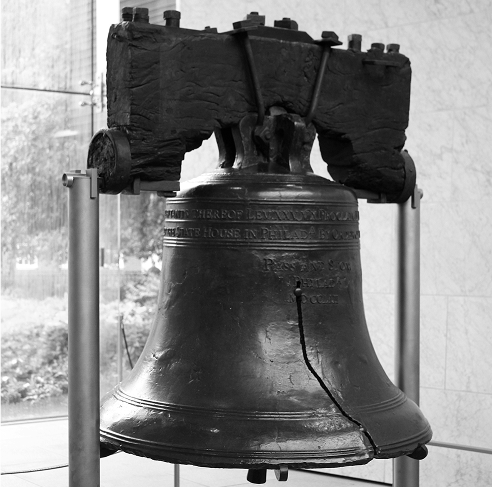

Ordered in 1751 to mark fifty years since William Penn’s Charter of Privileges for the colony of Pennsylvania, the Liberty Bell is inscribed with the words of Leviticus 25:10: “Proclaim liberty throughout all the land unto all the inhabitants thereof” (KJV).
Penn’s colonial secretary, James Logan, was a founding trustee of the College of Philadelphia (later the University of Pennsylvania) and served as mayor in Philadelphia. The historian Edwin Wolf has noted how Logan “bought himself Hebrew Bibles and Hebrew prayer-books, and read them and made notes in them … In fact, Logan gathered together in Philadelphia in the first half of the eighteenth century one of the largest collections of Hebraica which existed in frontier America.” Logan’s son-in-law, Isaac Norris, a Hebraist in his own right and the Speaker of the Assembly, was the one who commissioned the bell from the Whitechapel foundry in London.
In the Hebrew Bible, the context of the Leviticus verse is the Jubilee, the fiftieth year, when a ram’s horn sounded on Yom Kippur and debts were released, land was returned to families that previously owned it, and slaves went free. The Hebrew word for Jubilee, yovel, literally means ram’s horn. Pennsylvanians had traded the ancient antler for bronze.
Tradition has it that the bell was rung on July 8, 1776, when the Declaration of Independence was publicly read in Philadelphia. Known until the 1830s as the “State House Bell,” repeated cracks after multiple repairs eventually left the bell mute. But its symbolism grew. Newspapers from the 1830s into the 20th century show Americans reading Leviticus 25:10 as a prophecy, a rebuke, a centennial toast, and a battle cry.
Prophetic Power
In February 1835, an article titled “The Liberty Bell” appeared in The Anti-Slavery Record. Its author drew attention to the verse and asked whether emancipationists might live to hear it ring when liberty was truly proclaimed to all the inhabitants of the land. “May not the emancipationists in Philadelphia, hope to live to hear the same bell rung, when liberty shall in fact be proclaimed to all the inhabitants of this favored land? Hitherto, the bell has not obeyed the inscription; and its peals have been a mockery, while one sixth of ‘all the inhabitants’ are in abject slavery,” it lamented.
A few years later, abolitionist William Lloyd Garrison’s newspaper, The Liberator, helped popularize the name “Liberty Bell.” The name captured the movement’s conviction that the bell symbolized a summons to complete the work of freedom.
On July 6, 1839, The Voice of Freedom, an abolitionist newspaper published in Vermont, printed an argument by William Goodell about the remedy for slavery. Whether slavery was understood as a sin or a calamity, Goodell insisted, its remedy required removing the conditions that made it possible. He invoked the language of the prophets: “Undo the heavy burdens,” “Break every yoke,” and “Let the oppressed go free,” all from Isaiah 58:6. He then quoted the bell’s inscription of Leviticus 25:10.
In 1841, a Massachusetts paper’s description of “THE OLD BELL,” reprinted in the Bloomington Herald in the Iowa Territory, called the inscription “prophetic.” The bell, the writer claimed, had been first to announce independence in 1776. “Little did its manufacturers think,” he marveled, “that the solemn injunction to ‘Proclaim Liberty throughout the land,’ would be so soon obeyed.”
In 1845, the Ohio American Anti-Slavery Society resolved, in an essay published in the Anti-Slavery Bugle, to hasten the day when “Liberty shall be proclaimed throughout all the land,” relying on “the omnipotent power of truth.”
Warning of, and in, War
In 1849, former congressman Samuel Wright wondered in Washington’s Daily National Whig whether the vast new free soil on the Pacific might herald “a new Jubilee for 1850.” Then he turned to the “old bell of the revolution, which had tolled when our Fathers proclaimed that ‘all men were created equal.’” It had now “lost its bold and clear sound.” Its “silvery tone of freedom,” he wrote, had become “dissonant, jarring, and discordant, and its grating tremulous ring, mournfully wailed the temporary selfish victory of cruel prejudice.”
By July 1862, with the country at war, the Chicago Daily Tribune imagined Union soldiers who would “carry freedom with the flag, wherever it went—yea, more, they would proclaim ‘liberty throughout all the land and to all the inhabitants thereof.’”
Call for Celebration
Following the Union triumph and in celebration of America’s Centennial, on July 2, 1876, Rabbi Adolph Huebsch took Leviticus 25:10 as the text for his celebratory sermon at Congregation Ahawath Chesed in New York. The Bible’s Jubilee comes every fifty years, he reasoned, but given the “rapid stride of time in our age, a century of the present for five decades of the past may not be out of proportion.” Huebsch, the New York Herald reported,
paid a glowing tribute to the memory of those immortal heroes who stand in glory wrapped at the threshold of our free national life. Since they left us much progress has been made, but still the end of the century has much to learn from the beginning. The men of the Revolution, said the rabbi, were imbued with a deep religious feeling, holding the sword in one hand and the Bible in the other.
Two days later, the Eureka Daily Sentinel in Nevada opened its Fourth of July editorial with the verse in capital letters and traced it back “over three thousand years” to Moses at Sinai. “The voice of the grand old law-giver has resounded through the ages, and today its solemn tones still call mankind to rejoice for the work that has been done and to strive for the universal liberty that is to be.” Inspired by the story of Israel, the paper pondered America’s future:
The mission of the fathers of 1776, of the American people of to-day is but opening; but it is a mission of freedom and beneficence to all mankind, and it cannot fail. Let us, then, set our faces hopefully to the future, and, mindful of the great principle of individual liberty, strive each, in his sphere, as those have striven who have gone before us. The well-being of each of us, attained by his own exertions, is a contribution to the advancement of all.
The bell’s inscription, the editors wrote, “was in itself a prophecy.” They hoped America’s example would surpass “the vision of the Prophet,” and “Proclaim Liberty throughout all the earth.”
The Bell Returns to War
By the twentieth century, the verse had crossed the ocean. On the eve of July 4, 1918, and as hundreds of thousands of American troops fought in the Great War, Major William B. Gray wrote in the Harrisburg Telegraph that “the peal of the old Liberty Bell from the belfry of Independence Hall on that July morning 142 years ago proclaimed liberty to the thirteen struggling colonies scattered like a fringe along the Atlantic coast. But its echo has resounded back and forth across the Atlantic and throughout Europe.” “The words so prophetically inscribed on the bell,” he continued, “‘Proclaim liberty throughout all the land unto all the inhabitants thereof,’ have been graven in the minds and woven in the hearts of men in every land and clime.”
A year later, the Connecticut Western News imagined a new Independence Hall rising across the street from the old one, where free nations would sign a “Declaration of Interdependence.” It asked what might happen if the bell “were permitted to raise its cracked and wheezy voice” to proclaim liberty “to all the oppressed of the world.” Perhaps, said the writers,
That declaration will enable all free peoples to stand against the aggression of autocratic spoilers. It will assert the solidarity of all who stand for freedom and who love their fellow men. It will set forth the growing sense of human brotherhood. It will express in larger measure the high political ideals of our time. It may not ring in a thousand years of peace, but it will herald that dawn—When light shall spread …
Verse of Victory
On D-Day, June 6, 1944, Philadelphia’s Mayor Bernard Samuel tapped the bell to herald the Allies’ arrival in Normandy. On an NBC broadcast heard across the United States and Britain, he struck the bell (some accounts claimed seven times, once for each letter in “Liberty”) and quoted its inscription. He then added: “Let it, indeed, proclaim liberty throughout the land and the return of liberty throughout the world.”
In November of that year, the Washington Evening Star, citing the St. Louis Star Times, detailed how a “Cleveland engineer wants to weld the crack in the Liberty Bell so that the tones of that famed symbol of American independence can be added to the celebration” of an anticipated victory by the U.S. and its allies. “This is a drastic proposal,” the paper cautioned. It noted how:
The bell which proclaimed the Declaration of Independence on that July day in 1776 has been silent since 1835, when the crack developed during a tolling for the death of Chief Justice John Marshall. The crack has become a part of the bell, almost as much as the inscription—“Proclaim liberty throughout [all] the land unto all the inhabitants thereof.” No one living has heard the bell in true tone, but every one knows it by the crack, which shows in every picture. There probably is no question but that modern welders can make the bell whole again, but to the people of America it would not be the same bell if so repaired.
To celebrate America’s 250th birthday in July of 2026, the U.S. Mint released “Freedom Ringing—Liberty Bell Gold Coins and Silver Medal.” The “first non-round coin and medal in recent U.S. history” honors “the Liberty Bell’s timeless message of hope and perseverance as inscribed upon the bell, to ‘Proclaim Liberty Throughout All the Land Unto All the Inhabitants thereof.’”
While the bell’s crack remains to this day, so does its scriptural call to action. Originally delivered to the Israelites freed from Pharaoh, it has long driven America’s own march to freedom for all and liberty from tyranny.