
A text from the Hebrew Bible helped spark the American Revolution. Despite a historical irony that landed the individual who recited it on the wrong side of the conflict, the verses read on a fateful day in 1774 stand in timeless testimony to the power of Scripture to unite Americans in their fight for justice and liberty.
“For without cause have they hid for me their net in a pit, which without cause they have digged for my soul.”
The end of the French and Indian War in 1763 left Great Britain victorious but deeply in debt. To help pay for the costs of the war and strengthen control over its empire, the British government began imposing new taxes and regulations on the American colonies. In 1765, Parliament passed the Stamp Act, which taxed printed materials such as newspapers, legal documents, and pamphlets. Many colonists objected, arguing that they should not be taxed by a government in which they had no elected representatives, leading to the popular slogan, “no taxation without representation.”
British efforts to raise revenue continued with the Townshend Acts of 1767, which placed taxes on imported goods including glass, paper, and tea. In response, colonists organized boycotts and increased their resistance to British authority. Tensions continued to rise and reached a violent turning point in 1770 with the Boston Massacre, when British soldiers fired into a crowd and killed five colonists. The incident fueled anti-British feelings throughout the colonies.
“Take hold of shield and buckler, and stand up for mine help.”
Conflict escalated further in 1773 when the colonists staged the Boston Tea Party, dumping British tea into Boston Harbor to protest the Tea Act and British taxation policies. Britain reacted harshly in 1774 by passing the Coercive Acts, which the colonists called the Intolerable Acts. These measures punished Boston and limited colonial self-government, convincing many colonists that their rights were under attack.
In response, delegates from twelve colonies gathered in Philadelphia’s Carpenters’ Hall in September 1774 for the First Continental Congress (Georgia did not attend due to its reliance on British military protection against neighboring tribes). They coordinated a united response to British policies and laid the groundwork for greater colonial cooperation. George Washington attended as a delegate from Virginia.
“I will give thee thanks in the great congregation: I will praise thee among much people.”
In their preliminary gathering discussing the order of business, the delegates disagreed about whether to open their sessions with prayer. Future Chief Justice John Jay opposed the idea because their religious differences might make joint worship difficult. As John Adams recorded in a letter to his wife Abigail, Jay argued that “we were so divided in religious Sentiments, some Episcopalians, some Quakers, some Anabaptists, some Presbyterians and some Congregationalists, … that we could not join in the same Act of Worship.”
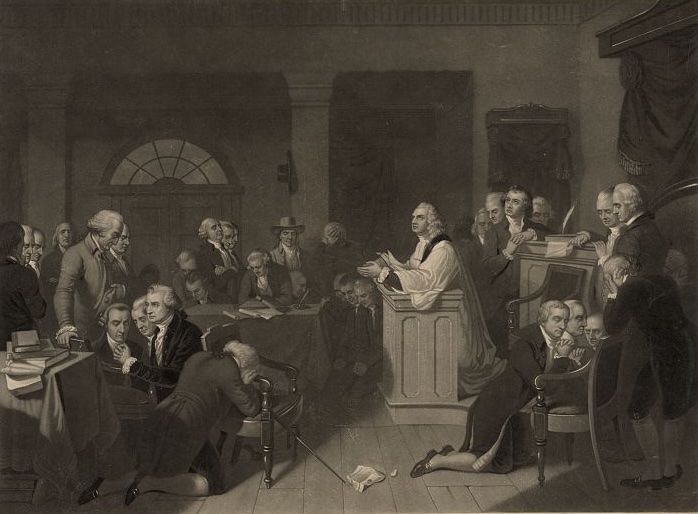
But Samuel Adams proposed inviting the Anglican minister Jacob Duché, rector of Philadelphia’s nearby Christ Church, to lead the prayer. Adams believed this would not only provide spiritual support but also demonstrate unity among colonists of different religious backgrounds—and it might encourage Anglicans to support the colonial cause. There were over 300 Anglican (Episcopalian) ministers in the colonies, each ordained by a bishop in England, with no bishop stationed in America.
“Stir up thyself, and awake to my judgment, even unto my cause, my God and my Lord.”
So it was that on September 7th, Duché opened Congress with a prayer centered on Psalm 35, a biblical passage about seeking God’s protection against oppression and enemies. It was the Psalm assigned for that day in the Book of Common Prayer, which Anglican ministers were mandated to use.
The psalm’s themes strongly resonated with the delegates, who saw parallels between David’s struggle and the colonies’ conflict with Britain.
John Adams wrote in his diary, “The Collect for the day, the 7th of the Month, was most admirably adapted, though this was accidental, or rather Providential. A Prayer, which he gave us of his own Composition, was as pertinent, as affectionate, as sublime, as devout, as I ever heard offered up to Heaven. He filled every Bosom present.” He later wrote to his wife Abigail: “I never saw a greater Effect upon an Audience. It seemed as if Heaven had ordained that Psalm to be read on that Morning. I must beg you to read that Psalm.”
Silas Deane, a delegate from Connecticut, stated that Duché “prayed with such fervency, purity, and sublimity of style and sentiment … that even Quakers shed tears.”
In Duché’s extemporaneous prayer, he asked God to “look down in mercy, we beseech thee, on these our American States, who have fled to thee from the rod of the oppressor and thrown themselves on Thy gracious protection, desiring to be henceforth dependent only on Thee.” He hoped the Lord would “give them wisdom in Council and valor in the field” so that “the scene of blood may be speedily closed; [and] that order, harmony and peace may be effectually restored …”
“With hypocritical mockers in feasts, they gnashed upon me with their teeth.”
In July of 1776, John Hancock appointed Duché as chaplain of the Continental Congress, but the minister soon lost faith in the revolutionary cause. When the British occupied Philadelphia in September of 1777, he was arrested by their troops. After his release, he read the tea leaves and decided to switch sides. (He was not alone; Anglican ministers had made vows of allegiance to the king. Many Anglican congregations navigated tensions over whether to recite the requisite prayers for “our most gracious sovereign Lord,” George III. New York’s state constitutional convention, on July 11, 1776, even asked Congress to suggest “measures for expunging from the Book of Common Prayer such parts … as interfere with the interest of the American cause.”)
Duché wrote to now-General George Washington, camped near Valley Forge, asking him to seek peace with Britain, claiming “your harbours are blocked up, your cities fall one after another, fortress after fortress, battle after battle is lost. A British army, after having passed almost unmolested thro’ a vast Extent of Country, have possessed themselves with ease of the Capital of America. How unequal the Contest now! How fruitless the expense of Blood!”
He even tried to appeal to Washington’s ego by arguing that if he put down his arms, “your character will rise in the Estimation of the virtuous and noble; it will appear with lustre in the Annals of History, and form a glorious Contrast to that of those, who have sought to obtain Conquests & gratify their own Ambition by the destruction of their Species and the Ruin of their Country.”
Shockingly, he had the gall to insist that Washington respond, writing a second letter five days later noting how “My mind will remain in a state of painful anxiety, ’till I have your candid answer …”
A determined and unfazed Washington did not respond, but rather forwarded the letter to Congress, noting, “I confess to you, that I was not more surprised than concerned, at receiving so extraordinary a letter from Mr. Duché, of whom I had entertained the most favorable opinion, and I am still willing to suppose, that it was rather dictated by his fears than by his real sentiments; but I very much doubt whether the great numbers of respectable characters, in the state and army, on whom he has bestowed the most unprovoked and unmerited abuse, will ever attribute it to the same cause, or forgive the man, who has artfully endeavoured to engage me to sacrifice them, to purchase my own safety.”
The minister was convicted of high treason to the State of Pennsylvania, and his estate was confiscated.
“Let them be ashamed and brought to confusion together that rejoice at mine hurt: let them be clothed with shame and dishonour that magnify themselves against me.”
In shame and fear, Duché fled to England. There he spent more than a decade preaching, publishing sermons, and associating with other exiled Loyalists. After numerous appeals to Benjamin Franklin and Washington himself went unanswered, he eventually returned to Philadelphia in 1793, where he lived quietly until his death in 1798. The Journal of the American Revolution records that shortly after his return he was pardoned by Pennsylvania’s first leader as a state, Governor Thomas Mifflin. And amazingly, Duché was able to meet with now-President Washington several months later. The meeting was reportedly cordial, though there is no record of what was said.
“Let them shout for joy, and be glad, that favour my righteous cause: yea, let them say continually, Let the Lord be magnified, which hath pleasure in the prosperity of his servant. And my tongue shall speak of thy righteousness and of thy praise all the day long.”
The resonance of Psalm 35 looms over the lost legacy of Reverend Jacob Duché. While undoubtedly he faced immense pressure, both from his denominational tradition and the British themselves, the minister made a massive mistake. But his citation of Scripture echoed on despite the disappointment the Founders had in his actions.
Stirred by the Psalmist’s plea to God to “fight against them that fight against me,” the Revolutionaries kept the faith. In the end, each and every individual who weighed whether to risk their lives in the name of American liberty could only hope that they would be deemed honorable as they prayed, “Judge me, O Lord my God, according to thy righteousness.”