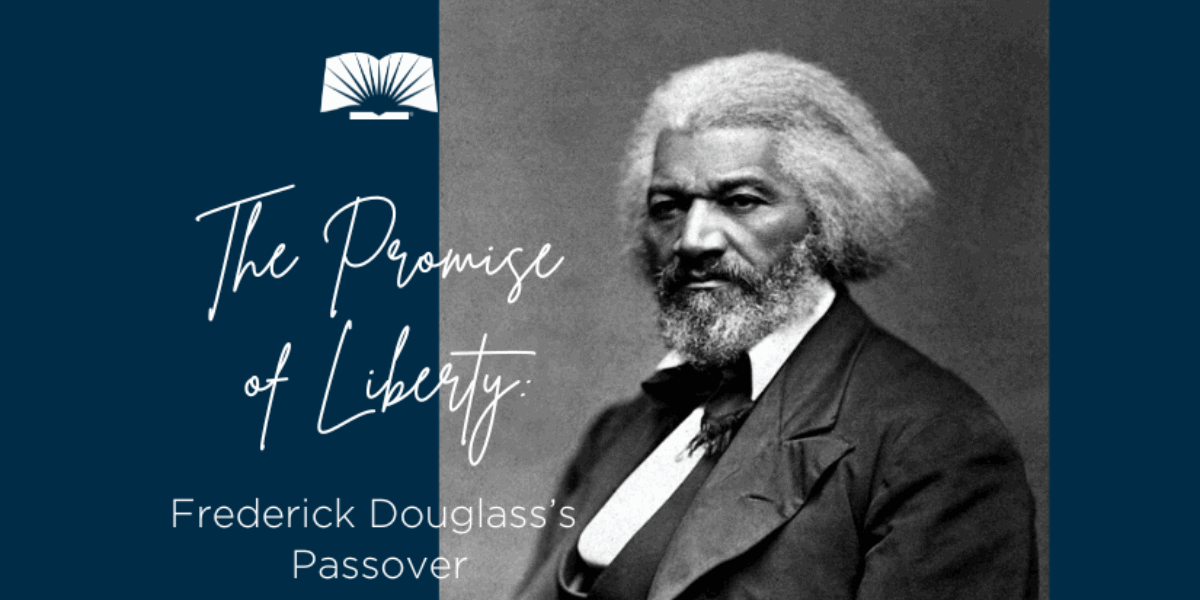

On July 5, 1852, Frederick Augustus Washington Bailey ascended to the podium at Corinthian Hall in Rochester, New York. The source of his moral argument for liberty that day would be drawn from the Jewish holiday of Passover, which begins this year on the evening of April 22.
Frederick’s Path to Deliverance
Born into slavery in Talbot County, Maryland in February of 1818, Bailey had never known his father. His mother had died when he was a boy. Fourteen years before that speech in Rochester, Bailey, aided by a young free black woman named Anna Murray, had dressed as a sailor and tucked a false ID into his pocket. He nervously boarded a train out of Baltimore, the site of his enslavement, and soon found employment as a free laborer in New York.
Showing a knack for public speaking, Bailey quickly became a popular lecturer for the growing abolitionist movement, though the specter of capture by human traffickers and re-enslavement loomed. He and Anna married and moved to New Bedford, Massachusetts. He published an autobiography in 1845 and soon left on a speaking tour of Ireland and England, away from danger. In 1846, his supporters in England arranged to finally, officially, purchase his freedom from brothers Hugh and Thomas Auld, whose family had held Bailey in slavery those years earlier.
In the meantime, Frederick and Anna had adopted a new last name: Douglass.
Two Stories of Exodus
So it was that summer day, seventy-six years after the Founders had signed the Declaration of Independence, that Frederick Douglass stood before an audience of 600, including President Millard Fillmore, and delivered a seminal speech against slavery threaded with references to Israel’s Exodus from Egypt.
Douglass began, as Moses had when called by God to appear before Pharaoh, by humbly lamenting a lack of natural rhetorical gifts:
I do not remember ever to have appeared as a speaker before any assembly more shrinkingly, nor with greater distrust of my ability, than I do this day. A feeling has crept over me, quite unfavorable to the exercise of my limited powers of speech.
Expressing “astonishment” and “gratitude” for being invited to address the assembly, he admitted that “the distance between this platform and the slave plantation, from which I escaped, is considerable—and the difficulties to be overcome in getting from the latter to the former, are by no means slight.”
Douglass then pivoted to the purpose of his talk. He had come, like the most skillful of sermonizers, to afflict the comfortable. He delivered a jeremiad, a sermon of rebuke like those delivered by the biblical prophet Jeremiah.
The Fourth of July, to Americans, “is the birthday of your National Independence, and of your political freedom.” It is “what the Passover was to the emancipated people of God.”
Using language familiar to readers of Exodus and the story’s retelling in the Passover Haggadah used in the Seder service, Douglass noted how the significance of the occasion “carries your minds back to the day, and to the act of your great deliverance; and to the signs, and to the wonders, associated with that act, and that day.”