
Exodus 15 and the American Battlefront
On December 12, 1787, at the state of Pennsylvania’s convention to ratify the Constitution, Dr. Benjamin Rush, a signer of the Declaration of Independence, asserted that the birth of the United States echoed ancient Israel’s exodus from Egypt.
The meeting’s minutes record that “he as much believed the hand of God was employed in this work [of drafting the Constitution], as that God had divided the Red Sea to give a passage to the children of Israel or had fulminated the Ten Commandments from Mt. Sinai!”
Rush’s affinity for analogizing Israel’s miraculous escape from the clutches of the tyrannical Egyptian monarch was apt. After all, the watery biblical scene and the victory hymn sung by the newly liberated slaves after Pharaoh’s forces were drowned—the “Song of Moses” or “Song of the Sea” in Exodus 15—have served as a source of American spiritual uplift throughout our country’s history.
Revolutionary Parallels
Amidst the Revolution, after the British abandoned Boston, a battle-weary General George Washington took his seat at Cambridge to hear a sermon. The text chosen by chaplain Abiel Leonard, as historian James P. Byrd recounts in Sacred Scripture, Sacred War, “described the moment when the Egyptians were mired in the middle of the Red Sea, unable to move forward and moments from being drowned in a flood when God, at Moses’s prompting, closed the waters … No text was more appropriate for America’s ‘Israelites.’”
In a letter to his wife Abigail on May 17, 1776, John Adams commented positively on a sermon he had heard:
A Parallel between the Case of Israel and that of America, and between the Conduct of Pharaoh and that of [King] George. Jealousy that the Israelites would throw off the Government of Egypt made him issue his Edict that the Midwives should cast the Children into the River, and the other Edict that the Men should make a large Revenue of Brick without Straw. [The preacher] concluded that the Course of Events, indicated strongly the Design of Providence that We should be separated from G. Britain.
Byrd, after surveying the writings of preachers and pundits during that era, calculated that Israel’s post-escape hymn was the third-most cited biblical chapter during the war. Ministers particularly and repeatedly quoted Moses’s proclamation that “the Lord is a man of war” (Exodus 15:3 KJV)
to reinforce God’s endorsement of warfare, and God’s blessing on soldiers who fight for just causes. “The Lord is a man of war” became a prominent text to cite against pacifists, especially those who proclaimed God’s preference for peace in all cases.
In other words, if you were waging a war, you needed both justification and reassurance that Heaven was on your side. Exodus 15:3 served both purposes.
In the same spirit, William Foster preached to soldiers in Pennsylvania in February 1776: “see how Pharaoh’s chariots and his hosts were cast into the sea … they sank as lead in the mighty waters” (Exodus 15:10). In fact, Foster argued, just as he had done for the Israelites, God had moved “great waters” to defend American patriots. He was alluding to the “Independence Hurricane” that struck Nova Scotia and Newfoundland in September 1775. During that storm, thousands of members of the British Royal Navy were killed. Foster couldn’t help but sense divine intervention in the parallel instance of God waging war with weather.
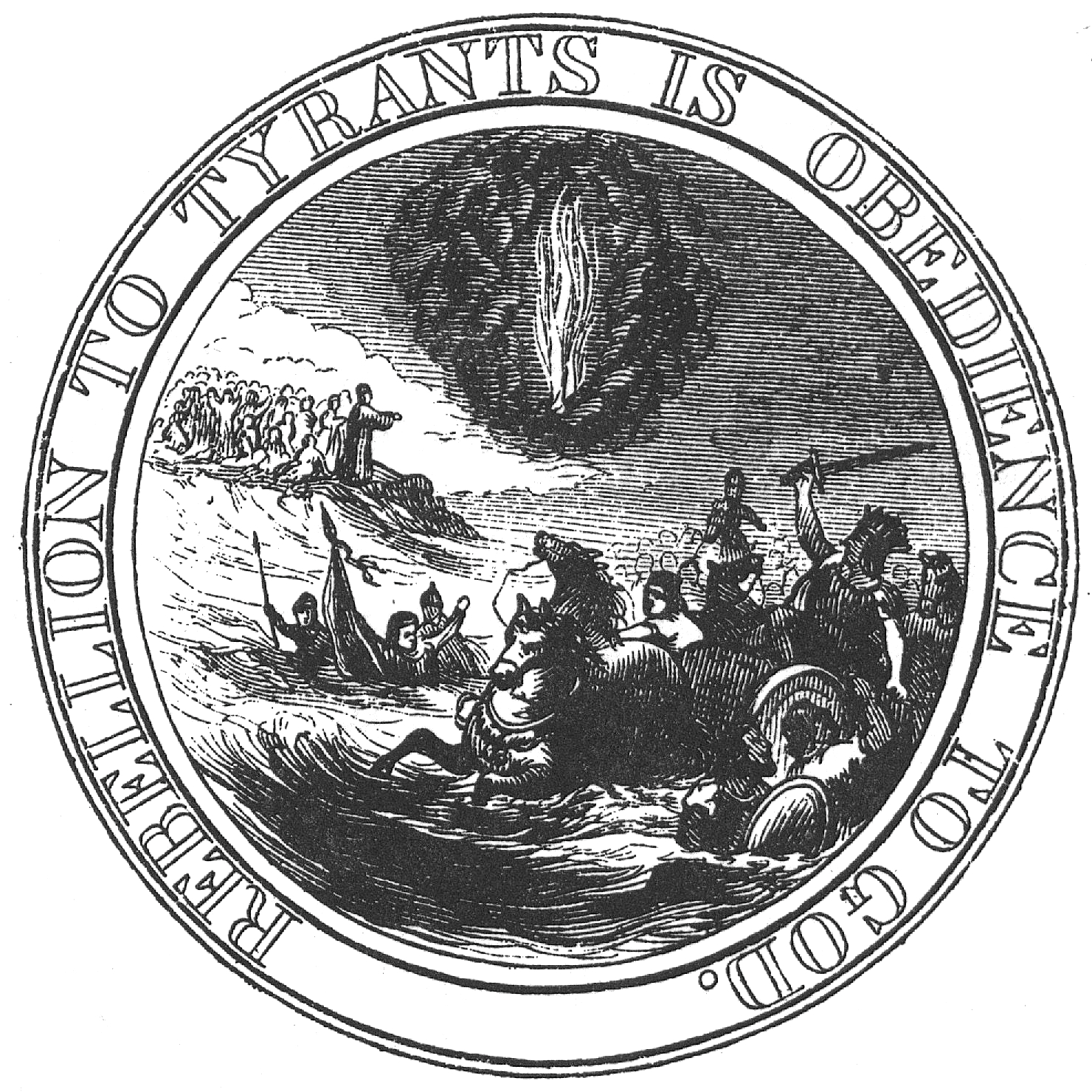
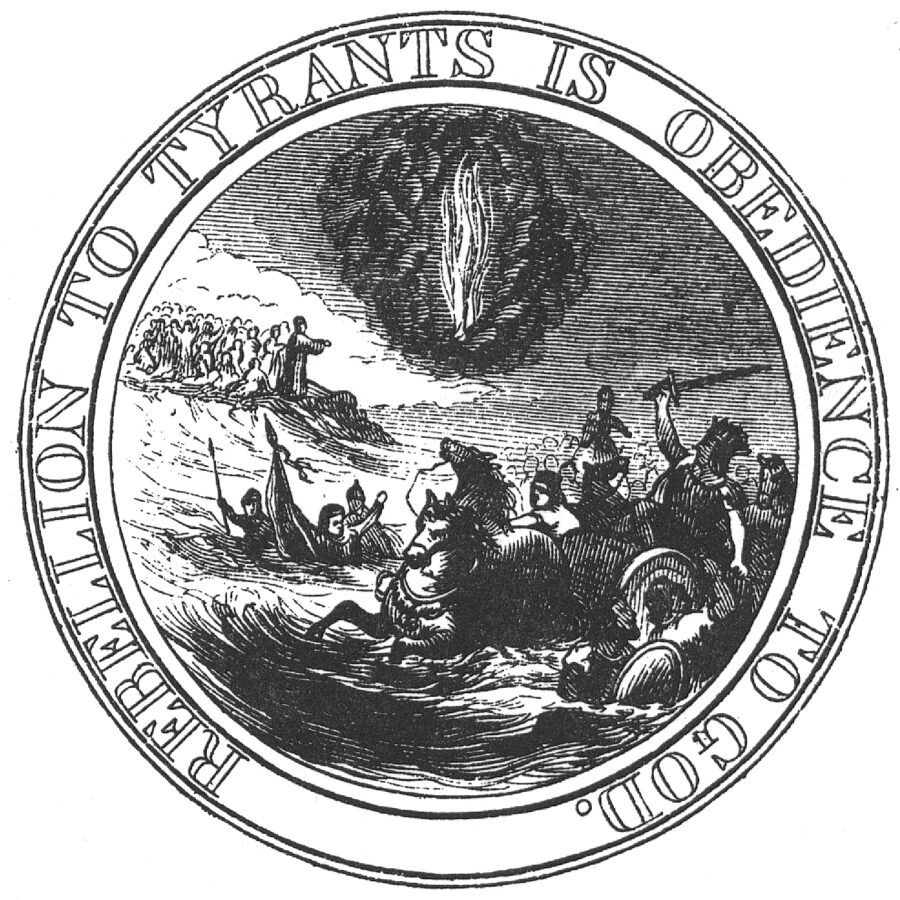
Little wonder then that two other Founders, Benjamin Franklin and Thomas Jefferson, suggested a snapshot of the episode be immortalized in America’s Great Seal. Jefferson, modifying an earlier suggestion by Franklin, put forward the idea that the national image of the U.S. be “Pharaoh sitting in an open Chariot, a Crown on his head and a Sword in his hand, passing through the divided Waters of the Red Sea in Pursuit of the Israelites: Rays from a Pillar of Fire in the Cloud, expressive of the divine Presence and Command, beaming on Moses who stands on the shore and extending his hand over the Sea causes it to overwhelm Pharaoh.”
Civil War Anthem
In the lead-up to the Civil War, the chorus of the splitting of the sea and its accompanying Song continued to ring. On May 18, 1842, the Vermont Telegraph criticized the supporters of slavery as “Blind and infatuated enemies of liberty! Will they never give heed to the warnings of history? Must experience teach her retributive lessons in vain?” It then cited Exodus 15:11 to anticipate their eventual defeat: “Who is like unto thee, O Lord, glorious in holiness, fearful in praises, doing wonders?”
The New York Times, in its April 15, 1861 issue, reported how abolitionist Henry Ward Beecher had quoted multiple lines of the Song, and told his audience in Brooklyn, New York, “Right before us brethren rolls the red sea, red indeed, for there is blood in it, and the word of God is, “Go on!”
The January 30, 1862 edition of Washington DC’s The National Republican cited the song of Miriam, which follows the Song of the Sea. In describing the slaves the paper hoped to see freed, they anticipated that “these children of oppression will make such an exodus from the house of their bondage as the world has not seen since that exodus of God’s people, which the dark-eyed daughters of Israel celebrated in that sublime song: ‘The Lord hath triumphed gloriously; the horse and his rider hath he thrown into the sea.’”
Ohio’s Cleveland Morning Leader, on January 6, 1863, cited Oberlin professor Henry Cowles as exuding over Northern victories by stating, “we recognize the hand of God in these wonderful events … Surely, it is not of man but of God that we this day stand on the farther shore of the Red Sea, to cry—‘Sing unto the Lord for he hath triumphed gloriously’” [Exodus 15:1].
Richard “Dick” Yates Sr. (1815–1873), thirteenth governor of Illinois, in October of that year similarly enthusiastically recounted how, at the Chicago Convention, he believed Lincoln to be:
the instrument in the hands of God to lead his chosen people to the banks of deliverance on the other side. You all recollect that when the children of Israel had encamped upon the banks of the Red Sea, when they saw the enemy behind, Pharaoh and his chariot and his horsemen, and the sea in front, what did Moses say unto them? He said “Hold still and see the salvation of the Lord” [Exodus 14:13]. You remember the triumphant song of Moses upon the other side; you remember the swelling symphonies of the chorus of millions as they shouted “Sing ye unto the Lord for he has gloriously triumphed; the rider and his host hath He thrown into the sea” [Exodus 15:21]. And when I sent my flaming dispatches to Mr. Lincoln—“issue your proclamation of confiscation and call out a million of men,” Old Abe telegraphed back to me, “Dick, hold still and see the salvation of God.”
Alas, the Confederacy also sought the mantle of Moses and the Children of Israel. Thus, on the occasion of the Southern victory at Manassas (known as the First Battle of Bull Run by the Union), Reverend G. D. Armstrong of the Presbyterian Church in Norfolk, Virginia preached from Exodus 15:2–3, beginning his thanksgiving sermon with a reading of a government proclamation:
On receiving official intelligence of our recent victory at Manassas, the Congress of these Confederate States unanimously “Resolved, That we recognize the Most High God, the King of Kings and Lord of Lords, in the glorious victory with which He has crowned our arms at Manassas, and that the people of the Confederate States are invited, by appropriate services on the ensuing Sabbath, to offer up their united thanksgiving and praise for this mighty deliverance.”
John Coffey notes other key connections in his Exodus and Liberation:
Like the Patriots in the American Revolution, African Americans saw in Exodus a call to fight as well as flight. Over 200,000 black men either fought in the Union army or served in its navy. At Fortress Monroe in 1861, an old Methodist class-leader among the contrabands told a Union general that “they were like the children of Israel in Egypt; they knew that deliverance was gwine to come.” In 1864, a black soldier, Thomas B. Webster, wrote from his camp in Virginia that he and his comrades were overthrowing Pharaoh as “in the days of old.”
In his best-selling memoir Army Life in a Black Regiment (1869), Thomas Wentworth Higginson, who commanded the first authorized Union regiment made up of freedmen, writes, “Their memories are a vast bewildered chaos of Jewish history and biography; and most of the great events of the past, down to the period of the American Revolution, they instinctively attribute to Moses.”
When the South lost and General Robert E. Lee surrendered, the April 10, 1865, Chicago Tribune described how “a great victory had been achieved for the cause of Freedom and the Union. Miriam’s hymn was chanted with fervent joy by thousands of loyal hearts.”
Maryland Congressman John Creswell also excitedly celebrated the arrival of days
when peace shall again reign with unbroken sway from ocean to ocean, and from the lakes to the gulf, and freedom, no longer vexed by the sight of a slave, shall sanctify to perfect fruition the inestimable fruits of labor, then, mindful of their great deliverance, let all the people, as they emerge from the stormy waters and tread again the dry land, join in the song of Him who aforetime led his brethren out of bondage: “Who is like unto Thee, O Lord, among the gods? Who is like Thee, glorious in holiness, fearful in praises, doing wonders? Thou in Thy mercy hast led forth the people which Thou hast redeemed: Thou hast guided them in Thy strength unto Thy holy habitation” [Exodus 15:11–13].
Boston Corbett, the American soldier who killed Lincoln’s assassin John Wilkes Booth, also had his own association with the Song. A writer in the March 27, 1881, Memphis Daily Appeal recounted: “I know Boston Corbett well. In 1874, when I was holding my first experimental national reunion here … Corbett addressed the reunion, and … preached a very eloquent extempore sermon from these words: ‘The Lord is a man of war, the Lord is His name.’ He is a fiery and eloquent speaker.”
Reverberating During Reconstruction
Following the ratification of the Fifteenth Amendment on February 3, 1870, which prohibited states from denying any citizen the right to vote based on “race, color, or previous condition of servitude,” General Hugh J. Campbell, per the New Orleans Republican, began a celebratory speech by citing Exodus 14:15, “Speak unto the children of Israel to go forward” and Exodus 14:14, “The Lord shall fight for you and you shall hold your peace.” He then continued:
On this day you stand on the shores by another Red Sea. For ten years has the same mighty hand that led the children of Israel four thousand years ago “upon dry land in the midst of the sea” [Exodus 14:22] led you through a bloody sea of war, civil strife, riot, massacre, and bloodshed safe to the other side … and today, five millions of colored people lead the chorus of forty millions of the other portion of this country in that same sublime song of triumph, “The Lord hath triumphed gloriously …”
Abolitionist William Lloyd Garrison echoed the excitement, and the citation, writing in the Weekly Louisianian:
May we trust our senses there is an end of all this wickedness—that a final and marvellous deliverance has been wrought for all in bondage? Yes, it is true; and there has been the same Divine interposition as of old. And the Lord said, “I have surely seen the affliction of my people which are in Egypt, and have heard their cry by reason of their taskmakers; for I know their sorrows and I am come down to deliver them out of the hand of the Egyptians” [Exodus 3:7]. “Thy right hand, O Lord, is become glorious in power; Thy right hand, O Lord, hath dashed in pieces the enemy!” [Exodus 15:6].
Hymn of Thanks
On Thanksgiving of 1873, Reverend O. Badgley of Millersburg, Ohio, echoed the Passover Haggadah and its citation of the “Declaration over the First Fruits” found in Deuteronomy 26 by recounting to his congregation how, in ancient times:
The children of Israel, at their annual Feast of Tabernacle or Feast of Ingathering, assembled from Dan to Beersheba in the temple to offer thanksgiving to God for the products of the soil, the fruit of the vine, and the blessings of the year. And on the occasion of any signal interposition of the divine power in their behalf [sic], they would break forth in songs of praise and thanksgiving to Him who had interfered for their protection or defense. Nearly 3400 years ago, a vast multitude stood on the shore of an eastern sea, on the border of the Arabian Desert. During the preceding night, God had opened for them a passage through the waters. Their enemies essaying [sic] to follow them, had been overwhelmed and destroyed. Their recognized leader now leads them in a song of praise, to which Miriam, the prophetess, and the other women respond in the chorus. “Sing ye to the Lord, for He hath triumphed gloriously; the horse and his rider hath he thrown into the sea” … How much more should we, as a nation, “come before His presence with thanksgiving” [Psalm 95:2].
That same year, Washington, DC’s New National Era recorded Professor J. M. Langston as declaring:
Our battle has been fought; our red, bloody sea has been crossed, and the song of redeemed millions, to the honor and glory of Him who gave us the victory, has been sung. Our words too have been, and justly, “I will sing unto the Lord, for He hath triumphed gloriously; the horse and his rider hath He thrown unto the sea. The Lord is my strength and song, and He is become my salvation. He is my God, and I will prepare Him an habitation; my father’s God, and I will exalt Him. The Lord is a man of war; the Lord is His name” [Exodus 15:1–3].
The first great thing, then, that the Republican party has accomplished is the maintenance of our national life, and the overthrow of slavery and the slave power of the country, and thus saved, and, as we trust, perpetuated, American freedom.
On Thanksgiving of 1898, Israel’s victory hymn would appear again in the context of the Spanish American War. Florida’s Ocala Evening Star recounted the words of the pastor of Lee Street Baptist Church: “The victory over Spain at Santiago is a fearful blow to superstition, ignorance, and tyranny,” said Reverend Westor Bruner. “It means that all oppressors shall be brought to their level, and that the ears of millions of oppressed shall hear the music of human liberty—music which they never heard before. Let us then, with Moses and the children of Israel, sing a song unto the Lord for he has triumphed gloriously.”
Still Singing in the 20th Century
In Kansas’s Topeka State Journal on November 28, 1901, the Song was again associated with Thanksgiving—in fact, it was credited with originating the very concept of the holiday. The Journal described how Reverend F. W. Emerson of the First Christian Church preached:
The first historical Thanksgiving, is recorded in Exodus 15:1–22, when the grateful hosts of Israel beheld the discomfiture of their taskmasters, the Egyptians. The burden of that Thanksgiving was “The Lord is my strength and song, and he is become my salvation. He is my God and I will prepare him an habitation, my father’s God and I will exalt him” [Exodus 15:2].
The hymn of Thanksgiving sung by Moses and his followers is an appropriate one for the American people of today.
In the waning days of Teddy Roosevelt’s presidency in 1908, Ohio’s Greenville Journal called for greater investment in the military from an uncommitted Congress. “Our present Congress is not making any great history,” the paper claimed:
They must think as congressmen that battleships are not peace makers. Well some of our congressmen are very religious and perhaps have been reading the songs of Moses in the Bible. Moses sang, “The Lord is a man of war, and the Lord is his name.” So they depend on the Lord to fight for us, instead of a large navy. Does Roosevelt, like Moses, say, “Stand still and fear not”? I trow [believe] not. The president wants a big stick for he knows we are afraid of a man with a club, if we have no gun handy. “In peace prepare for war.”
A few years later during World War I, Salt Lake City’s Goodwin’s Weekly evoked the Song to argue for an anti-militaristic perspective and keep the U.S. out of the conflict, cautioning that:
As the war is going on all Europe will in a little time be one vast house of mourning and more than half the people left will be bankrupt. It will be as it was in Egypt on that dreadful night when the first born died, “When there was not a house where there was not one dead and there was a great cry throughout all the land of Egypt such as there was none like it” [paraphrasing Exodus 11:6 and 12:30]. And it will be no comfort to stricken mothers, wives and sisters if some one has the temerity to sing: “I will sing unto the Lord for He hath triumphed gloriously. Pharaoh’s chariots and his host hath he cast into the sea; his chosen captains also are drowned.”
Ironically, when the U.S. did enter, and win, World War I, the November 29, 1918 edition of the Daily Gate City of Keokuk, Iowa reported on the local celebration, titling one section, “God Has Triumphed as of Old.” It reprinted the words of Chaplain George D. Long:
The noblest answer to the question why we sing, is found in the song of Moses when he said, “I will sing unto the Lord for He has triumphed gloriously; the horse and the rider hath He thrown into the sea. Thy right hand, O Lord, is become glorious in power; thy right hand, O Lord, hath dashed in pieces the enemy …” [Exodus 15:6]
We sing … because God has through us and our allies, bowed that proud head, and that not autocracy but righteousness triumphed; that henceforth the righteousness of God and the righteousness of a people shall dominate.
We sing because democracy is able to give expression to its principles. We who have in this country believed in its principles, can face the whole world and know that everywhere the will of the people must have place.”
The Song also accompanied the modern-day revival of its original singers, the nation of Israel. Following the Balfour Declaration, England’s stated commitment to support the restoration of the Jewish homeland in the land of Israel, the January 26, 1918 edition of the New York Tribune recounted a moving story:
“Long, long ago,” said one shawled old woman on the East Side, “I remember in the old country—in Romania—we used to celebrate it a little—just by ourselves, you know. The Sabbath of the Song we called it—after the Song of Moses, you know, that is read in the temples—and I remember when I was a little girl my mother giving me the bread crumbs from the table and telling me to go out and strew them to the birds, because it was the Sabbath of the Song. But that was long, long ago.”
Today, though, the Song of Moses—that paean that begins “I will sing unto the Lord, for he hath triumphed gloriously: the horse and his rider hath He thrown into the sea”—will sound as a new clarion call to the hosts of Jewry.
The last time it sounded through the temples, a year ago, Jerusalem was in alien hands; Secretary Balfour had not yet given Lord Rothschild the pledge of the British government’s aid in securing Palestine as a national Jewish homeland; the “chosen people” were still in the wilderness. Now the first ecstatic flush of joy at the changed order has passed.
Additionally in 1918, the Song was cited arguing for equal rights for black Americans. The Phoenix Tribune, on November 16, ran an essay by S. E. Newell with a reminder for those fighting for equality: “We realize fully that Jehovah is a man of war—the Lord is His name. As a race, we are weaker far than David, when the pride of Gath he slew. Yet the God in whom he trusted will give us the victory, too. He will guide us in the battle of the right against wrong, what though we are small and feeble, He is ever wise and strong.”
Decades later, anticipating America’s decisive role in the Second World War, Washington, DC’s Evening Star, on August 7, 1943, predicted:
In the first flush of their deliverance, the Hebrews were jubilant. It is easy to praise God in the hour of success. Songs would soon be succeeded by complainings. For the moment paeans of victory rang through the camp. Moses led in a great psalm, improvised, as is still the usage of the Arabs. His sister Miriam, shaking a timbrel like a Salvation Army lassie with a tambourine, led the women in the exultation:
“Sing ye to Jehovah, for He hath triumphed gloriously; The horse and his rider hath He thrown into the Sea.”
It was all like the celebrations of Armistice Day, after the first World War. The people let themselves go, in delirious expressions of their pent-up feelings.
Such again will be the tumult of rejoicing when this war has ended in unconditional surrender.
One might conclude, then, that well before the Star-Spangled Banner, America has had a national anthem of ancient biblical verses. The Song of the Sea has long accompanied the country’s sacred march through turbulent waters, towards liberty and justice for all.