
The Founders of the United States sprang up from a soil that might have been brought directly from the Promised Land. Countless American towns and territories draw their names from the Hebrew Bible. Ararat, Bethel, Bethlehem, Eden, Gilead, Goshen, Hebron, Jericho, Joppa, Mizpah, Mt. Carmel, Mt. Gilboa, Mt. Hermon, Mt. Horeb, Mt. Moriah, Mt. Nebo, Mt. Olive, Mt. Tabor, Naomi, New Canaan, Newark (“New Ark”), New Jerusalem, Pisgah, Rehoboth, Salem, Shiloh, Siloam, and Zion constitute only a partial list.
No wonder that our nation’s leaders have historically possessed an affinity for the Holy Land in both its ancient and modern iterations. After all, the covenantal story of Israel was intentionally used to shape the American landscape and self-identity.
A Biblical Frame
The American tale itself has long been told in scriptural style. In a representative example, on February 21, 1803, the Alexandria (Va.) Expositor ran an article titled “The First Book of the Kings,” in which Congress was “the great Sanhedrim of America” (a reference to the Great Court of ancient Israel, known as the Sanhedrin) and the American capital was “Jerusalem.” The country was led by “George [Washington, who] reigned over all Israel,” while James Madison “assembled together his household and went with them up to Jerusalem, and called a grand council of the nation to deliberate upon all these things.”
Writings in this pseudobiblical genre continued for decades. William Wedgwood, a law professor at The University of the City of New York, in an 1860 tract titled “The Reconstruction of the Government of the United States of America,” pointed out that the Israelites
were in bondage in Egypt for four hundred and thirty years. Then God brought them out of Egypt, leading them by a pillar of cloud … He opened the gates of the sea for their passage.… He gave them his covenant amid the thunders of Sinai. For forty years he led them through the wilderness … He then … planted his chosen people, in thirteen [Canaanite] States.… Prosperity and happiness followed them, and their name and their fame went out to the ends of the earth.
Now, “in after days,” Wedgwood believed, God had “selected another people and planted them … in thirteen States.… He led them through the Red Sea of the Revolution … He gave this people another covenant, by the hand of another Moses.”
In her 1869 novel Oldtown Folks, in which she drew from her husband’s memories as a child in New England, abolitionist Harriet Beecher Stowe described the daily pattern of prayers of a member of the first generation following Independence: “They spoke of Zion and Jerusalem, of the God of Israel, the God of Jacob, as much as if my grandfather had been a veritable Jew; and except for the closing phrase, ‘for the sake of thy Son, our Saviour,’ [his prayers] might all have been uttered in Palestine by a well-trained Jew in the time of David.”
So it was not surprising that in the decades leading to the birth of the modern State of Israel in 1948, American presidents expressed deeply rooted support for the Jewish people and their ancient homeland. As Carl Richard has extensively documented,
American presidents were raised in a biblical culture that pervaded their schools, homes, churches, and society. Until the mid-twentieth century, the curricula of most public schools included Bible reading … Most presidents were also influenced by devout parents and grandparents, who inculcated biblical principles in the home, as well as by pious siblings and wives. Most attended church services throughout their lives, listening to sermons that quoted Scripture extensively. This biblical culture was continually reenergized by the religious revivals that led directly to the American Revolution, the Civil War, the Progressive Era, and the modern civil rights movement.
Through Celebrations and Depression, God’s Word Lifted Spirits
At the celebration at Carnegie Hall of 250 years of Jewish presence in America on November 30, 1905, former president Grover Cleveland articulated the role of Jews in America and how the U.S. based itself on the Bible:
All nationalities have contributed to the composite population of the United States—many of them in greater number than the Jews. And yet I believe that it can be safely claimed that few, if any, of those contributing nationalities have directly and indirectly been more influential in giving shape and direction to the Americanism of to-day.…
Columbus, on his voyage in search of a new world was aided in a most important way by Jewish support and comradeship.… [T]he Jews among us have in their care and keeping the history and traditions of an ancient Jewish commonwealth astonishingly like our own Republic in its democracy and underlying intention. This ancient commonwealth was ordained by God for the government of His chosen people; and we should not close our minds to a conception of the coincidence in divine purpose discoverable in the bestowal, by the Ruler of the Universe, of a similar plan of rule, after thousands of years, upon the people of the United States, who also had their beginning in willing submission to God’s sovereignty, and the assertion of freedom in His worship.
A few years later, on January 6, 1913, delegates from the International Order of B’nai B’rith arrived at the White House to give President William Taft a gold medal for trying to improve the lives of Russian Jews and for his services to the Jewish community. As the New York Times reported, in thanking them, Taft said:
In their just pride of their ancestry, those of us who are not of the Jewish people have to be humble. The genius, the strength of your race, the patience, and the persistence with which you pursue your purpose to maintain your rights and exalt your race—all make yours an exceptional history in the history of the world. The persecutions to which you have been subjected because of your religion have in a sense doubtless developed the character and tenacity of your race, but it needs a free country like the United States to develop the flower and enable you to show to the world at large the wonderful capacity of the race as supporters of law and order in a Government of freedom and a Government that insists upon equality before the law.… [I]t is a great satisfaction that this movement of the Jews upward and onward to complete and world-wide recognition of their merit and to social justice everywhere has had its most successful impulse in this country.
At the laying of the cornerstone of the Jewish Center in Washington on May 3, 1925, President Calvin Coolidge proclaimed: “May they give due credit to the people among whom the Holy Scriptures came into being. And as they ponder the assertion that ‘Hebraic mortar cemented the foundation of American democracy,’ they cannot escape the conclusion that if American democracy is to remain the greatest hope of humanity it must continue abundantly in the faith of the Bible.”
The Bible served as a source of succor during trying times. In 1929, during the Great Depression, Hebert Hoover declared, “As a nation we are indebted to the Book of Books for our national ideals and representative institutions. Their preservation rests in adhering to its principles.”
Following his presidency, in 1938, with the Nazis ascending, Hoover argued that “religious faith, morals, and democracy are indissolubly allied in the fate of the world.” And at his eightieth birthday party in 1954, he applied the Bible’s timeless teachings to the Cold War: “The great documents of that heritage [of freedom] are not from Karl Marx. They are the Bible, the Declaration of Independence, and the Constitution of the United States. Within them alone can the safeguards of freedom survive,” he declared. No surprise, then, that he was supportive of Jewish national renewal. In 1932, Hoover wrote to Emanuel Neumann of the Zionist Organization of America:
I am interested to learn that a distinguished group of men and women is to be formed to spread knowledge and appreciation of the rehabilitation which is going forward in Palestine under Jewish auspices, and to add my expression to the sentiment among our people in favor of the realization of the age-old aspirations of the Jewish people for the restoration of their national homeland.
A Promised Land Revived
FDR echoed this sentiment on February 6, 1937, during that year’s United Palestine Appeal, when he recounted how:
The American people … have watched with sympathetic interest the effort of the Jews to renew in Palestine the ties of their ancient homeland and to reestablish Jewish culture in the place where for centuries it flourished and whence it was carried to the far corners of the world.
This year marks the twentieth anniversary of the Balfour Declaration … Those two decades have witnessed a remarkable exemplification of the vitality and vision of the Jewish pioneers in Palestine. It should be a source of pride to Jewish citizens of the United States that they, too, have had a share in the great work of revival and restoration.
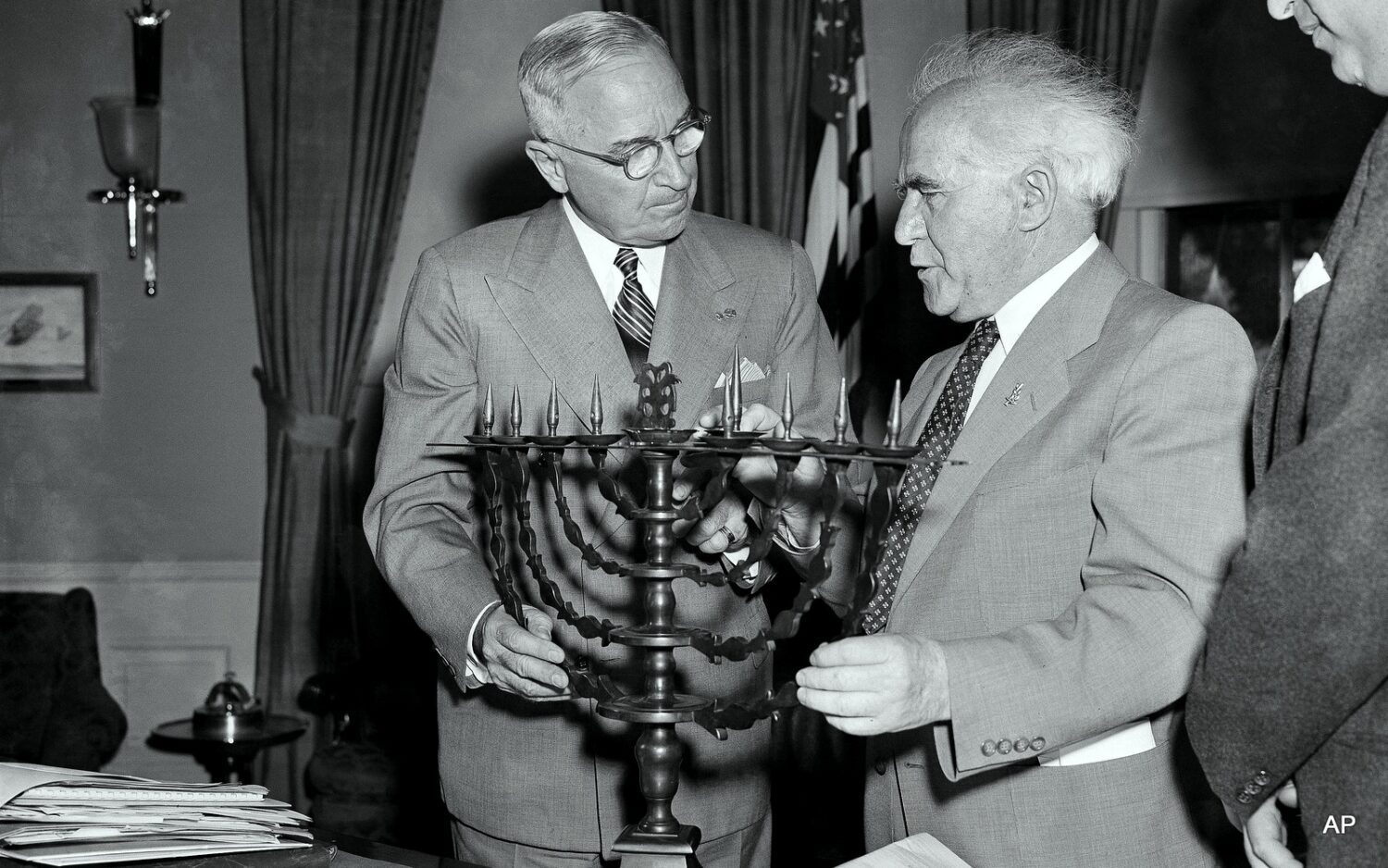
President Harry Truman, who recognized Israel eleven minutes after Israel declared itself a state following the UN’s Partition Plan, proudly noted in 1952 that “the growth and progress of the new State of Israel are a source of great satisfaction to me. I had faith in Israel even before it was established. I knew it was based on the love of freedom, which has been the guiding star of the Jewish people since the days of Moses.” In his farewell address, Truman, who once called himself “Cyrus” after the ancient Persian king who allowed the Jews to return to Judea in 538 BCE, drew a direct line from ancient Israel to its modern iteration by predicting, “Israel can be made the country of milk and honey as it was in the time of Joshua.”
In a 1956 celebration at New York’s Yankee Stadium of Israel’s eighth anniversary, then-Senator John F. Kennedy expressed wonder as to how
a desert had been reclaimed—and a national integrity had been redeemed, after 2,000 years of seemingly endless waiting. Zion had at last been restored—and she had promptly opened her arms to the homeless and the weary and the persecuted. It was the “Ingathering of the Exiles” … they had come from concentration camps and ghettos, from distant exile and dangerous sanctuary, from broken homes in Poland and lonely huts in Yemen …
He acknowledged that:
Much is different between the United States and Israel. Our Nation stretches in a great land mass between two wide oceans—the Israelis occupy a beachhead on the eastern Mediterranean. Americans number 165 million—the Israelis less than 2 million. We are the oldest Republic on earth and the youngest people—the Israelis have the youngest republic and the oldest people.
Yes, much is different—but much is the same. For both Israel and the United States won their freedom in a bitter war for independence. Both Israel and the United States acknowledge the supremacy of the moral law—both believe in personal as well as national liberty—and, perhaps most important, both will fight to the end to maintain that liberty.
Kennedy concluded by joyfully proclaiming:
Today we celebrate her eighth birthday—but I say without hesitation that she will live to see an eightieth birthday—and an eight hundredth. For peace is all Israel asks, no more—a peace that will “beat swords into plowshares and spears into pruning-hooks” [Isaiah 2:4]; a peace that will enable the desert to “rejoice and blossom as the rose [Isaiah 35:1],” “when the wicked cease from troubling and the weary be at rest [Job 3:17].” Then, and only then, will the world have witnessed the complete fulfillment of Isaiah’s prophecy “Tzee-Yon B’Meeshpat Teepadeh”—“Zion shall be redeemed through justice [Isaiah 1:27].” And all of us here, and there, and everywhere will then be able to say to each other with faith and with confidence, in our coming and in our going: “Shalom”—peace! Peace be with you, now and forever.
JFK’s successor, Lyndon Johnson, echoed the sentiment, telling Israeli president Zalman Shazar in 1966, “our Republic, like yours, was nurtured by the philosophy of the ancient Hebrew teachers who taught mankind the principles of morality, social justice, and universal peace … God has showered our land with abundance. The sharing of our blessing with others is a value we hold in common with Israel.” Two years later, in a speech to the B’nai B’rith, Johnson quoted Isaiah 11:12: “And he shall set up an ensign for the nations, and shall assemble the outcasts of Israel, and gather together the dispersed of Judah from all the four corners of the earth.” He then added, “Most, if not all of you, have very deep ties with the land and with the people of Israel, as do I, for my Christian faith sprang from yours. The Bible stories are woven into my childhood memories as the gallant struggle of modern Jews to be free of persecution is also woven into our souls.” This support is not a surprise in light of the advice Johnson received from his aunt in Texas, by way of his brother. She had instructed, “Tell him to stick with the Jews and never do anything against them. Now, they’re God’s chosen people, you know. Says so right in the Bible, and don’t you ever doubt it. The best thing Harry Truman ever did was create the state of Israel.… So, you tell Lyndon never to let the Jews down. They’re the best people to have on your side. In politics or anything else.”
Testifying to the Ties that Bind
In November of 1973, Gerald Ford, commenting on “The New Colossus,” the poem by the Jewish American Emma Lazarus that adorns the Statue of Liberty, remarked, “I think those words on the Statue of Liberty capture the essential spirit of both America and Israel—almost uniquely among the nations of the world—havens for the persecuted, the homeless, the oppressed. And it is because of this unique common tradition, I believe, that the bonds between America and Israel are so very close.”
In 1979, Ronald Reagan referred to the revival of the Jewish nation as “carrying out a centuries-old Bible prophecy.” Two years later, when speaking to Israeli Prime Minister Menachem Begin, he said: “The prophet Ezekiel [36:35] spoke of a new age—when land that was desolate has become like the Garden of Eden and the waste and ruined cities are now inhabited. We saw how miraculously you transformed and made the desert bloom.” And in his memoirs, Reagan wrote, “no conviction I’ve ever held has been stronger than my belief that the United States must ensure the survival of Israel.”
George H. W. Bush expressed his happiness with Russia finally allowing Jews to emigrate by citing Exodus 15:1: “‘Let my people go.’ Those were the words of Moses nearly 4,000 years ago, when the Israelites took the first step on the march from captivity to freedom … The modern exodus is a great event for all who delight in human freedom.”
In a 1998 speech in Jerusalem, Bill Clinton promised “The United States will always stand with Israel, always remember that only a strong Israel can make peace … The United States stood with Israel at the birth of your nation, at your darkest hour in 1973, through the long battle against terror, against Saddam Hussein’s Scuds in 1991. And today, American Marines and Patriot missiles are here in Israel exercising with the IDF.”
Birthdays and a Biblical Bond
A decade later, George W. Bush, celebrating Israel’s 60th birthday in the Knesset, recapped how:
on the orders of President Harry Truman, the United States was proud to be the first nation to recognize Israel’s independence. And on this landmark anniversary, America is proud to be Israel’s closest ally and best friend in the world. The alliance between our governments is unbreakable, yet the source of our friendship runs deeper than any treaty. It is grounded in the shared spirit of our people, the bonds of the Book, the ties of the soul. When William Bradford stepped off the Mayflower in 1620, he quoted the words of Jeremiah [51:10]: “Come let us declare in Zion the word of God.” The founders of my country saw a new promised land and bestowed upon their towns names like Bethlehem and New Canaan. And in time, many Americans became passionate advocates for a Jewish state.
Five years after that, Barack Obama, in a speech at Tel Aviv, expressed his admiration for how “More than 3,000 years ago, the Jewish people lived here, tended the land here, prayed to God here. And after centuries of exile and persecution, unparalleled in the history of man, the founding of the Jewish State of Israel was a rebirth, a redemption unlike any in history. Today, the sons of Abraham and the daughters of Sarah are fulfilling the dream of the ages to be masters of their own fate in their own sovereign state. And just as we have for these past 65 years, the United States is proud to stand with you as your strongest ally and your greatest friend.”
The Covenantal Connection Continues
Donald Trump, in his own Knesset remarks in 2025, expressed astonishment as to how “even after 3,000 years of pain and conflict, the people of Israel have never given up from the threats of Zionism, from all sorts of threats. You want—you want the promise of Zion. You want the promise of success and hope and love and God. And the people of America have never lost faith in the promise of a great and blessed future for all of us.” Trump’s successor and predecessor Joe Biden repeatedly called himself a Zionist, once remarking “Israel owes this remarkable and yet improbable success, I believe, to your democratic traditions, to its patriotic and pioneering citizens, and as with my own country, to its willingness to welcome the persecuted and the downtrodden from far-flung corners of the globe.”
Eran Shalev, in a 2021 article titled “The Old and the New Israel: The Cultural Origins of the Special Relationship,” summarizes the history well:
[I]t seems that centuries of conditioning in biblical rhetoric eventually produced a sense of kinship toward the Old Israel and translated into a position that was favorable toward the Jewish national project. It would thus be fair to conclude that the notion of the New Israel, after helping to construct a national American identity, facilitated attitudes that were favorable toward the return of the original Chosen People to their biblical homeland and secured their continued support. By creating the rhetorical conditions to view the United States as a New Israel, American Biblicism also enabled the injection of the Jews as a nation back into history.
That is to say, America’s sense of itself as a moral echo of biblical Israel enabled the rebirth of the ancient Jewish homeland in the modern era.
Image: President Harry Truman receives a menorah from Israeli Prime Minister David Ben Gurion in the Oval Office, May 8, 1951. Photo credit: AP, Henry Griffin, 1951. Believed to be public domain.